Insurance Structure and Margin: A Practical Review for Irish Construction Businesses
Why the strongest construction businesses treat their insurance programme as a decision, not a default.
The strongest construction businesses treat their insurance programme the way they treat any other major contract, reviewed regularly, not renewed on autopilot. Where risk sits, how cover tracks the order book, when premiums fall due, and how the business is presented to the market are the decisions that matter most.
These are not one-off decisions. An self-insured excess level agreed at one renewal, a cover extension added at another, a payment date fixed years ago and never revisited. Each decision looks minor on its own. Reviewed together, they show whether the programme has kept pace with the business, or simply accumulated over time.
Where does risk actually sit?
Excess and deductible levels are a genuine design choice, not a fixed setting. A higher retained excess keeps more frequent, smaller losses with the business. A lower excess shares more of that risk with insurers, smoothing their effect on project accounts. Neither is inherently right. The appropriate level depends on the business’s loss history and cash position, and it is worth revisiting as both change.
Does cover still match the order book?
Construction businesses move quickly. New forms of work, new contract structures, new jurisdictions and new partnerships can enter the order book within a single year. Insurance programmes are written against the business as it stood at a point in time, so alignment is not something achieved once. Design responsibility, contractual liability, and joint venture or consortium work are the areas where misalignment tends to matter most, and reviewing cover against the current order book, rather than last year’s activity, keeps protection matched to the projects it actually stands behind.
For construction firms reviewing their insurance, see our construction insurance page.
Is premium timing working for the business?
When your insurance premium falls due is a decision worth making deliberately. A single annual payment suits many businesses well. Others align payment more closely with project cash cycles through staged structures or premium financing. Financing may carry an interest cost, and the right choice should be considered based on the needs of the business.
Is the business showing underwriters what it is worth?
Turnover, wage-roll and similar figures are the starting point for most underwriters, not the full picture. The assessment that follows takes in project mix, contract forms, claims history, and risk management maturity, including health and safety systems and site supervision. Two businesses with similar headline figures can represent very different propositions to the same insurer. A submission that sets out the risk management position clearly, gives context to the claims record, and presents the order book accurately allows insurers to price with confidence rather than caution. In practice, that can mean better terms, broader cover, and more insurers competing for the risk.
Where to go from here
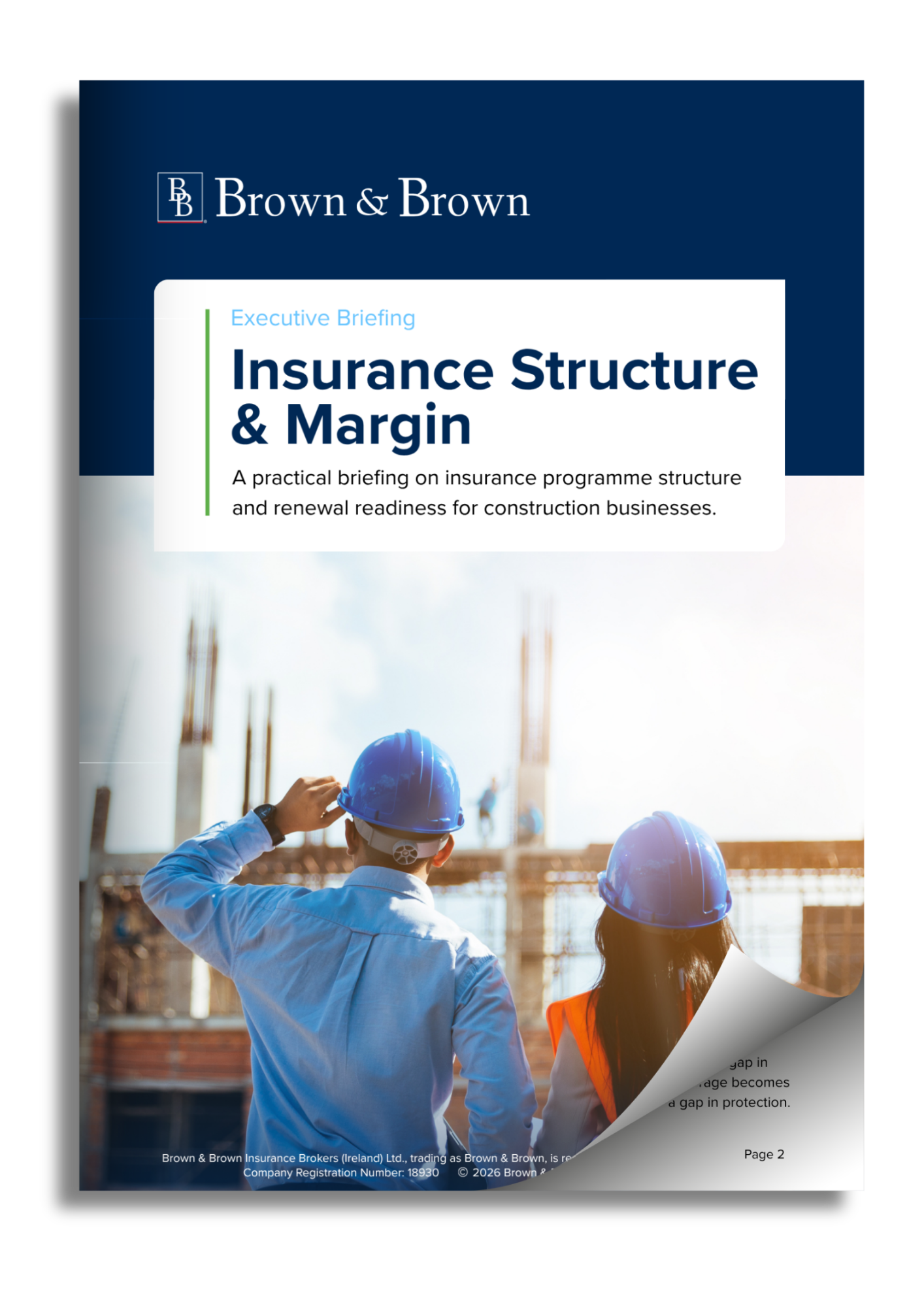
Brown & Brown (Ireland) has produced an Executive Briefing on Insurance Structure and Margin for decision makers in Irish construction. It looks at excess structure, cover alignment, the pace of project delivery, premium timing, what underwriters value beyond turnover, and how presentation can shape price, cover and terms.
Request your copy by emailing [email protected], and our team will follow up to discuss what it means for your business.
Brown & Brown Insurance Brokers (Ireland) Ltd., trading as Brown & Brown, is regulated by the Central Bank of Ireland.
Get the Full Briefing
Access our executive briefing paper and speak with our construction specialists.